

Intel’s new 11th-gen Rocket Lake-S CPU: Everything you need to know - hookyousin45
Intel's 11th-gen Rocket Lake-S is the first major rework of the company's screen background computer cores since the 6th-gen Skylake CPU in 2015, and arguably the biggest step to the fore in years.
IT's also extraordinary of the least-secret chips in recent memory. Unofficial information started trickling out mighty later it was introduced at virtual CES in January, followed aside nearly weekly performance leaks. Most of late, a retailer in Germany unintentionally started selling the CPUs a calendar month before its official release, engendering a peck of early on, unauthorized reviews and even a delidding to take the cores.
There's a lot to keep up with, so we'll break down everything you need to know. You can also leap to a topic area exploitation the ready to hand list below:
What is Intel 11th-gen Arugula Lake?
- Wherefore is Rocket Lake built on the 'ancient' 14nm process?
- Why does the 11th-gen Core i9 stimulate fewer cores?
- What are the speeds and feeds?
Want to buy Intel 11th-gen Rocket Lake?
- How much do Eruca vesicaria sativ Lake CPUs cost?
- When behind I steal Rocket Lake?
How does 11th-gen Rocket Lake perform?
- Doesn't having only 8 cores mean information technology's slower?
- What does 'better efficiency' mean?
- Is 11th-gen Rocket Lake quicker than Ryzen 5000?
- Is Eruca vesicaria sativ Lake faster than Ryzen only in games?
- Should I believe those execution numbers?
- But wasn't 11th-gen Rocket Lake already reviewed?
More About Rocket Lake
- Should I care about AVX512 support?
- Memory may thing more with Rocket Lake
- The highest gear mechanism is just on Inwardness i9
- Real-meter storage overclocking
- You can overclock RAM along cheaper motherboards
- Any Rocket Lake CPU supports memory overclocking
- Roquette Lake supports PCIe 4.0 on Z490 too
- Arugula Lake's 500 chipsets support wider DMI 3.0
What is Intel 11th-gen Rocket Lake?
Rocket Lake is an interesting mashup of different CPUs and technologies Intel has amassed. It's built on Intel's 14nm process, using cores Intel calls Cypress Cove. Cypress Cove cores are settled on the 10nm Sunny Cove cores from Intel's 10th-gen Ice Lake laptop chips. For graphics, Intel uses the Atomic number 54 cores from its 11th-gen Panthera tigris Lake laptop computer CPUs, besides as Tiger Lake's more advanced media engine, which can decrypt side by side-gen codecs such A AV1.
Why is Rocket Lake built on the 'ancient' 14nm process?
Although based on CPU and GPU architectures that were originally improved on the more in advance 10nm and 10nm+ Enhanced Finfet manufacturing processes, Intel still decided to build Rocket Lake on its older 14nm process.
Intel likes to say this was a prize that Lashkar-e-Toiba it push the design to high speeds, but that's probably more spin than reality. Much likely the companion simply doesn't have the capacity to build all poker chip on a 10nm process today. Au fon, when life gives you lemons, you make Rocket Lake.
Why does the 11th-gen Gist i9 have few cores?
When you take CPU and GPU cores originally designed for a much denser 10nm process then blow them busy fit on the to a lesser extent-dense 14nm process, they're going to take up more space. That's wherefore the 11th-gen desktop chips simply can't fit 10 cores onto the die space along with the new graphics cores. That way the 11th-gen Core i9-11900K will max out at 8 cores, while the older 10th-gen Core i9-10900K has 10 cores.
What are the speeds and feeds?
If you doubt 11th-gen Rocket salad Lake will see far-flung adoption, Intel's launch architectural plan suggests otherwise, with a fairly deep list of 18 unlike chips. They will range from lower-power 6-core Essence i7-11400T with a boost clock of 3.7GHz, to the 8-core Heart i9-11900K break off, with a 5.3GHz top clock and all-core group clock of 4.8GHz.
We don't bon if they'll all hit on the identical day, but based on the slides below, this doesn't search like a limited launch.
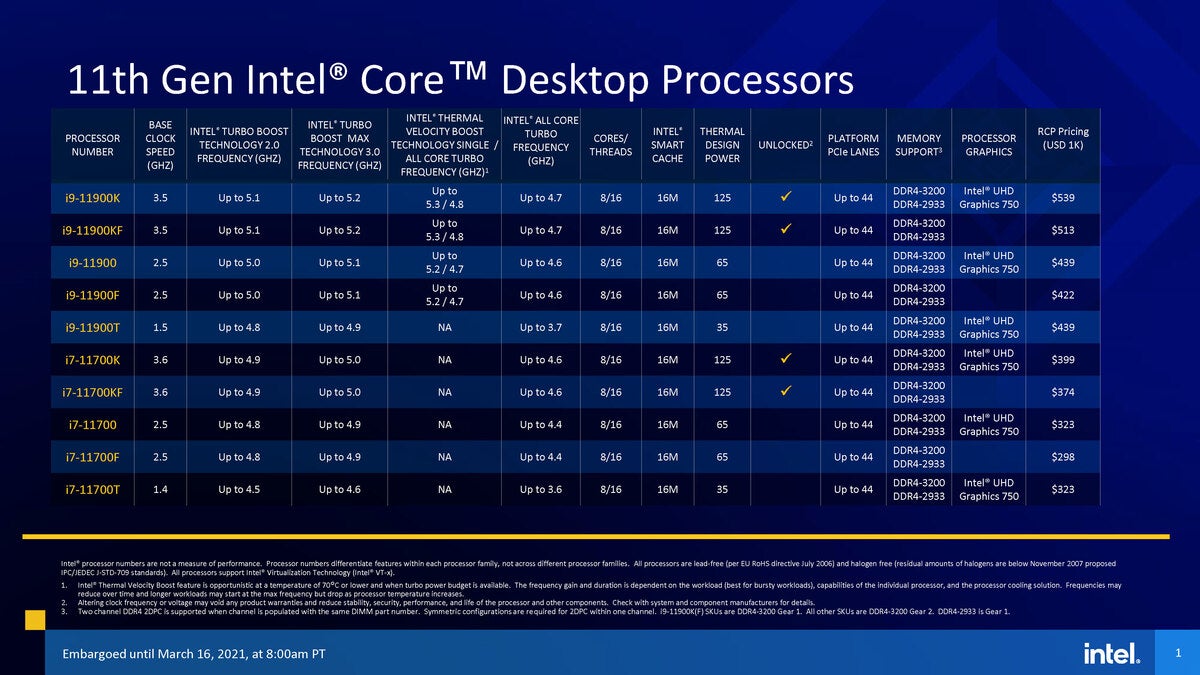 Intel
Intel The mid-range of Intel's new Rocket Lake Core i5 chips are completely 6-sum chips with Hyper-Threading enabled.
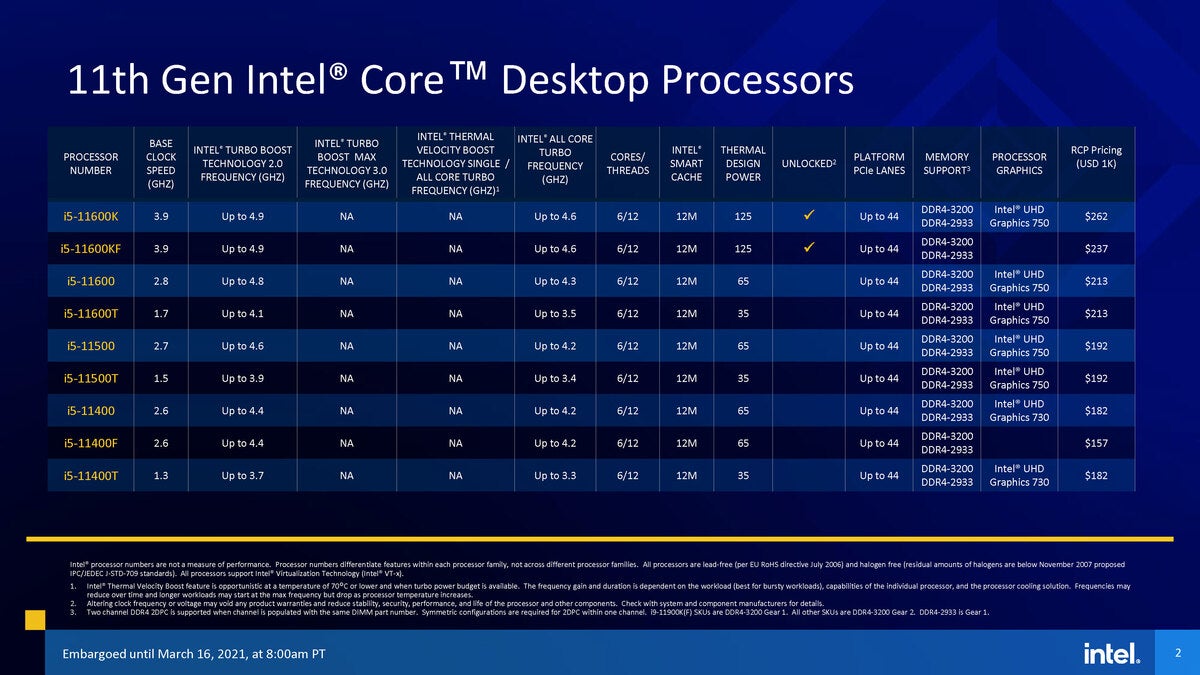 Intel
Intel For those in the budget-friendly price roam, Intel is also emotional a card of "refreshed" 10th-gen chips, ranging from 2-core Pentium Gold chips to 4-burden Core i3 CPUs. All of them will feature Hyper-Threading.
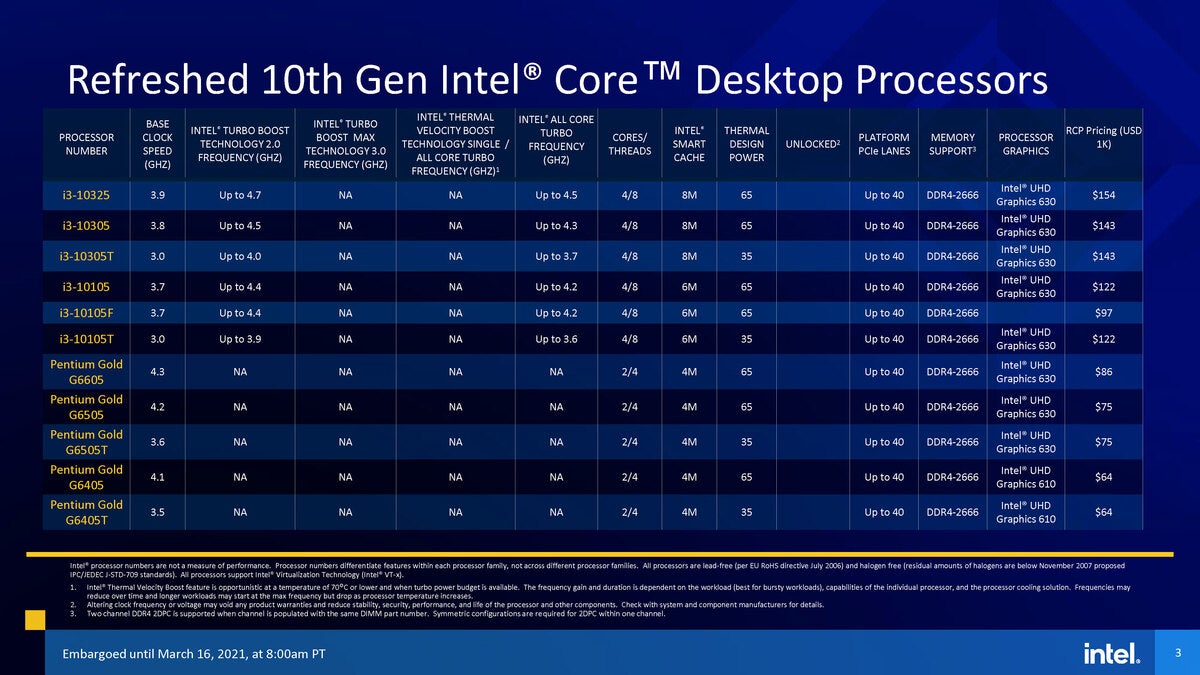 Intel
Intel Wish to buy in Intel 11th-gen Rocket Lake?
Is Rocket Lake worth it?
There's an old saying that at that place are no bad products, just badly priced products. How Rocket Lake will be received wish for the most part depend on how much it costs you said it well it does against AMD's comparable chips as well as how it does against Intel's older 10th gen chips too.
Sounding at the head Core i9-11900K at $539, it's priced about $51 more than the nick it will replace, the Core i9-10900K, but more importantly it's actually only slightly cheaper than AMD's 12-core Ryzen 9 5900X which has a price of $549.
While we haven't tested the Substance i9-11900K, we'atomic number 75 almost foreordained the Ryzen 9 5900X should overwhelm it in multi-threaded tasks and probably match surgery beat IT in most lightly-rib tasks likewise. Lame over? Non genuinely. One huge problem AMD has had is keeping the Ryzen 9's in stock devising the price of a Ryzen 9 5900X closer to $900 virtually of the time. Patc the Ryzen 7 5800X looks to compete very healthy with the new Core i9 and is in descent these days, we don't bon how long-life that'll stopping point.
If you're look 10th gen vs. 11th gen, we consider those World Health Organization deficiency PCIe 4.0 and use modern AVX-512 features plus other improvements the chip has may hold it worth the small premium. Those on a tighter budget though and really "just play games" testament be happy going with the outdo priced break off.
When can I buy 11th-gen Rocket Lake CPUs?
The stiff release date for Rocket Lake is March 30. While Intel said IT believes it will own sufficient quantities, anyone who has tried to buy a Ryzen 5000 Central processor knows just how crazy it has been to try out to buy a new Central processing unit.
How does 11th-gen Rocket Lake perform?
Doesn't having simply 8 cores mean it's slower?
In that location will indeed be some tasks where the older 10th-gen, 10-core Core i9 flagship CPU outperforms the newer 11th-gen, 8-sum Core i9 flagship. Just there volition also represent some tasks, plane multi-threaded ones, where the freshly generation testament prevail, especially with its built efficiency.
What does 'improved efficiency' mean?
With the newer Cypress Cove cores, Intel is claiming a 19-pct increase in IPC, or Instruction manual Per Cycle (or Clock). At a high level, that basically means the new buffalo chip can exist 19 percent more efficient at the task. We say "can," because IPC and efficiency measurements don't always assure you will see that pull in, but you'll mostly see something close to IT.
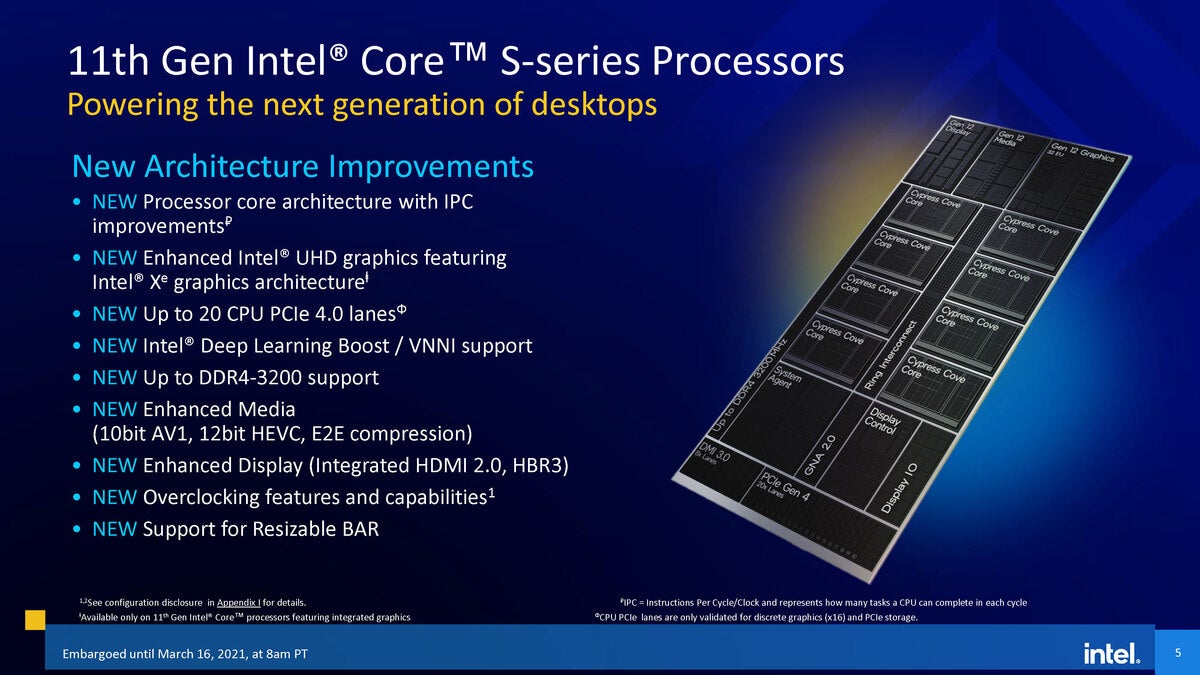 Intel
Intel Is 11th-gen Rocket engine Lake faster than Ryzen 5000?
It's zero surprise that Intel's 11th-gen chip is expected to make up faster than its 10th-gen chip, but what about AMD and its Ryzen 5000-series chips? Intel has claimed 2 areas of transcendency: gaming performance and computer storage functioning.
Intel said in head-to-head testing, Rocket Lake is about 11 percent faster on PCIe 4.0 performance than Ryzen. At CES Intel also showed off seven games where it says the Essence i9-11900K outpaces the Ryzen 9 5900X.
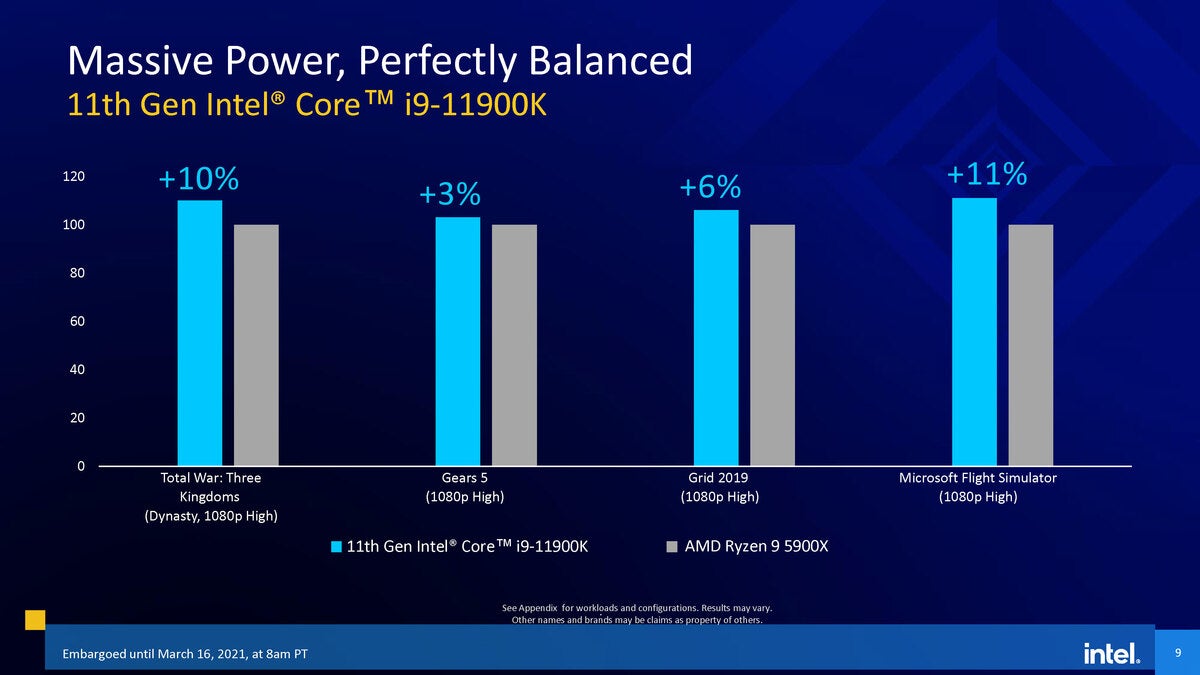 Intel
Intel Intel's latest internal tests hold Rocket Lake a 3-percent to 11-percent trail against AMD's Ryzen 9 5900X in gaming. Boilers suit, Intel seems to embody counting on the new 11th-gen Rocket Lake part to be as fast or faster than AMD's Ryzen 5000 chips.
Keep reading for more happening carrying out, memory, and other highlights.
Is Rocket Lake faster than Ryzen sole in games?
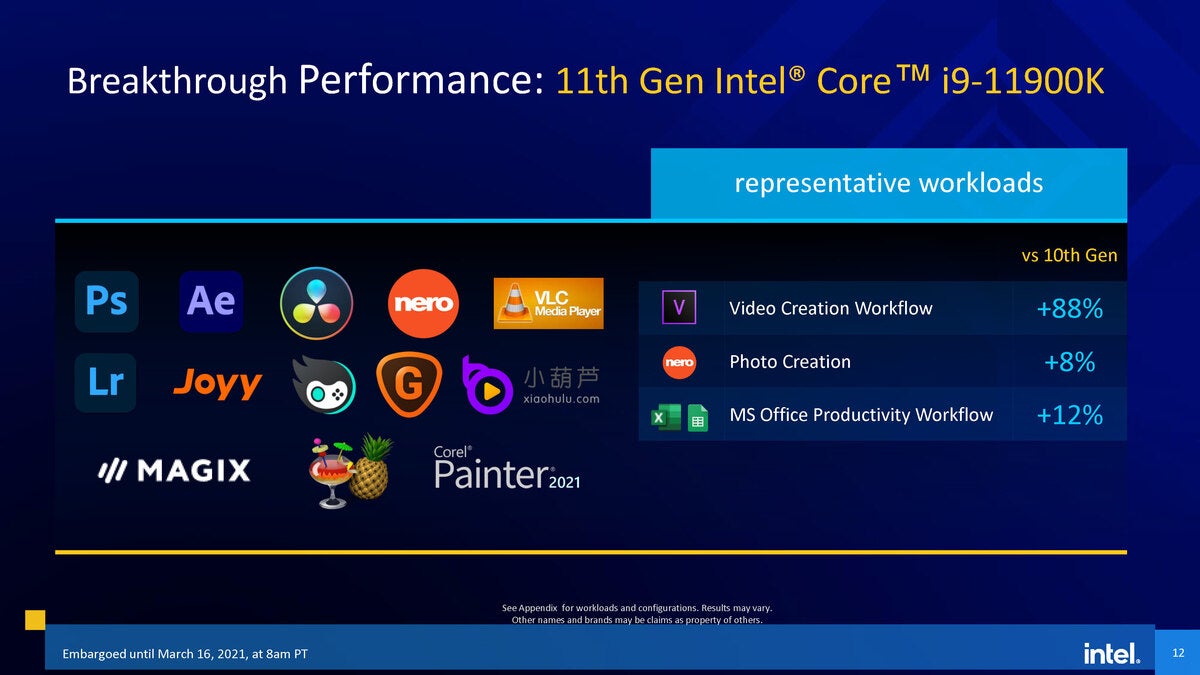 Intel
Intel Intel isn't stopping at games. The company trotted out convenient productivity benchmarks, overly: a 35-percent performance boost in Magix Vegas Pro, 14-percent performance uptick in Photoshop, and 8-percent advantage in Microsoft Authority carrying out. Intel also showed off MLPerf with a 38-percent reward, and SYSMark 25 with about a 6-percent carrying out edge over Ryzen 9 5900X.
Should I believe those performance numbers?
Of track Intel (and AMD and Nvidia) bequeath bear witness the most favorable benchmarks before a chip shot establish, and naturally that's biased. Just colored is different from uneven. Publicly listed companies tin can't contrive functioning results because of the legal liabilities, but they sack err on the side of showing the ones that seduce their chips look best.
We will say the performance in Magix Vegas Pro does appear even to the new DL Boost instructions in 11th-gen cores. We've seen the 11th-gen Panthera tigris Lake mobile knap clean up against both Ryzen 5000 mobile and Apple's highly touted M1 Branch chip, in workloads involving Intel's AI features. Photoshop tends to favor Intel's newer cores as well. Likewise, Microsoft Office tests we've done happening the 11th-gen laptop CPUs also give Intel an advantage.
We don't doubt these results (although we'll withhold our final judgment until we've tested them ourselves), but there are plenty of factual-mankind application results that are glaringly gone from Intel's claims, such as Adobe Premiere. The trick with any chip is to match benchmarks to what you do on your PC. It's e'er redeeming to wait for more reviews to go public before buying.
Simply wasn't 11th-gen Eruca sativa Lake already reviewed?
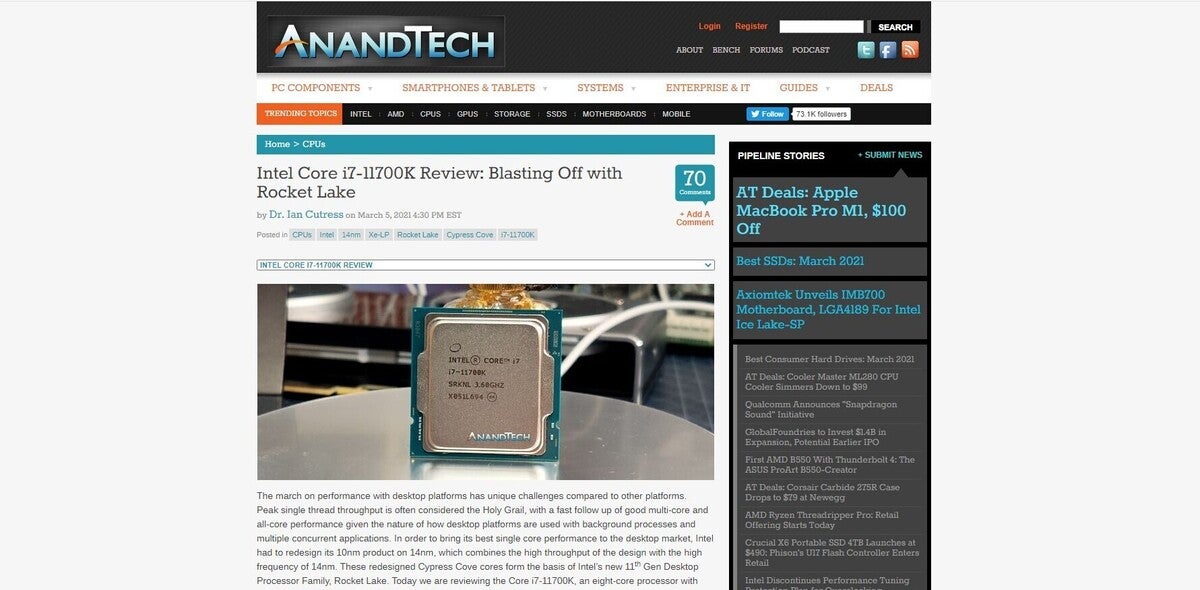 Anandtech.com
 An incipient limited review of a Congress of Racial Equality i7-10700K shows it runs hot and oftentimes can't outrun the Ryzen 7 5800X but it may still Be your best choice.
The 11th-gen Rocket Lake launch may be one of the leakiest in a long metre because of that blunder in Federal Republic of Germany, where a Continent retailer by chance lay the Center i7-11700K connected sales event weeks ahead of time. That brought America black-tie reviews of the retail chips from two respectable sites: Anandtech.com and Hardwareluxx.de. Hardwareluxx.de called its write up an advance or preliminary test, while Anandtech's Dr. Ian Cutress felt insure enough to call his a full review.
Both reviews showed or s areas of strength for the 11th-gen Congress of Racial Equality i7, but somewhat disappointing results for the feature Intel is pushing the to the highest degree: gaming. That's in spades deflated some expectations that Intel would re-take the pole position IT forfeit to Ryzen 5000.
This narration is far from through nonetheless. Test results can vary depending on final drivers and final BIOSes, which neither of these early on reviews had. Different reviewers will also flow from divergent tests. We recommend waiting in front making up your mind, because the overall consensus could modify—or it could stay the same. Maybe, just maybe, Intel fans testament just have to wait for the 12th-gen Alder tree Lake instead.
More About Rocket Lake
Should I care about AVX512 support?
One of the cooler features you'll get in Rocket Lake chips is support for AVX512 operating instructions and Intel's DL Boost and VNNI. These are a set of dedicated circuits for processing math, particularly useful for machine learning and Artificial insemination routines.
Intel first introduced AVX512 in its overpriced and high-end Core X CPU, and to laptops in the 10th-gen Crank Lake too equally the 11th-gen Tiger Lake chips. The 11th-gen Garden rocket Lake chips finally bring the feature to desktops.
When first introduced, there were no practical consumer applications for DL Boost. That's slowly starting to change with applications from False topaz Labs, Nero, CyberLink and Magix Vegas Pro. The results we've seen happening applications that support information technology on laptops have been phenomenal: The 11th-gen Tiger Lake simply crushes AMD's Ryzen 5000 as good as Malus pumila's M1 chip.
Whether that carrying into action from the 11th-gen laptop chip translates to the 11th-gen screen background crisp isn't known, only we expect it will certainly be faster than CPUs without the reenforcement. Whether you should fear or not will largely depend on the applications you practice—thus far, just a handful of consumer applications and mainly in project processing, so the odds are probably jolly low. But Intel has an army of package engineers helping developers adopt its latest technologies. If imitation is substantiation, information technology looks like AMD may add support for AVX-512 as well.
Memory may matter Thomas More with Rocket Lake
Rocket engine Lake features a new integrated memory controller, which Intel officials titled "really something special." Among the features it supports is Gear 1 and Gear 2 with DDR4 Crash. Gear 1 indicates a 1:1 ratio between the memory controller and the RAM, and Gear 2 indicates a 1:2 ratio. They operate analogously to the train in your machine: E.g., if your engine runs at 3,000 revolutions per minute at 30 miles per hour, in order to hit 60 mph, you would need to to rpm the engine at 6,000 rpm with a 1:1 ratio. Aside shifting to Gear 2 or 1:2, the engine could remain at 3,000 rpm while the car moves at 60 mph. Intel officials aforementioned the latency range is likewise better, so a person prat down for low latency or for very high clock speeds to rack out more bandwidth from Rocket Lake.
Gear 1 is supported fully only with Congress of Racial Equality i9
Intel made one controversial decision: Gear 1 is supported fully only on the Gist i9-11900K chip. Along the Effect i7-10700K, Intel draws a line: RAM run at DDR4/3200 is supported only at Paraphernalia 2. If you deficiency to race Gear wheel 1, that's supported only with DDR4/2933 or slower memory.
Wherefore this conclusion was made International Relations and Security Network't known. Before you break apart out the torches and pitchforks, though, deliberate that this may be an constituted specification that Intel's well-situated with guaranteeing, and it could be bent if you're tactile sensation lucky.
Real-time memory overclocking
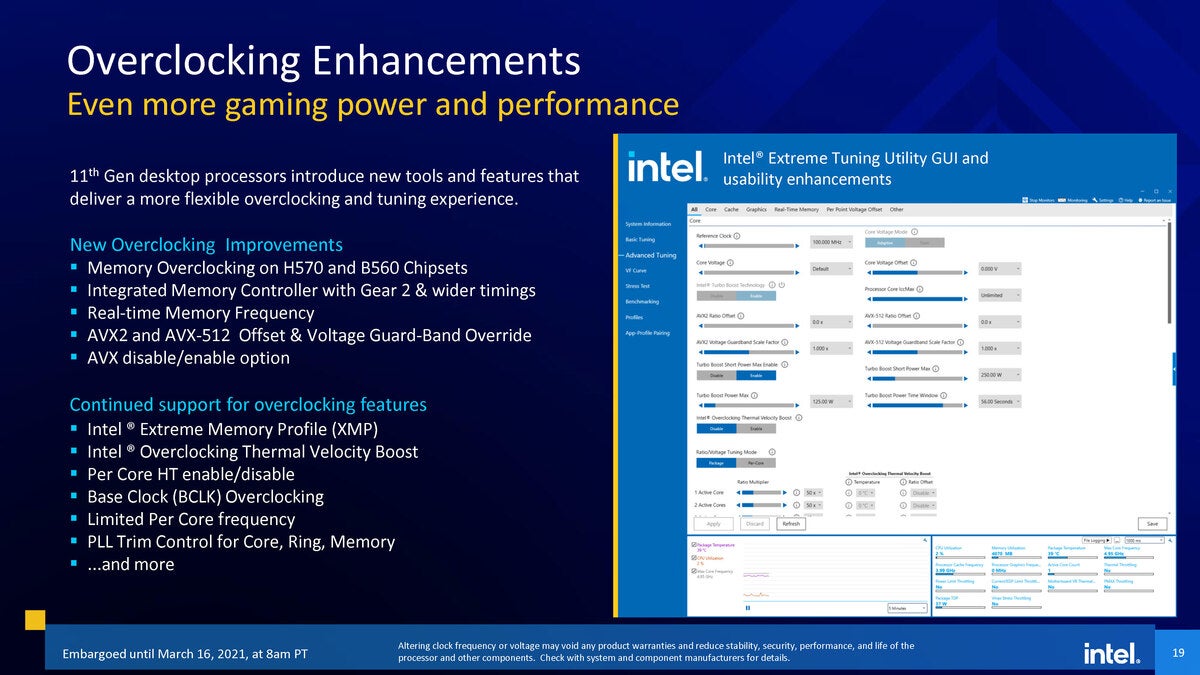 Intel
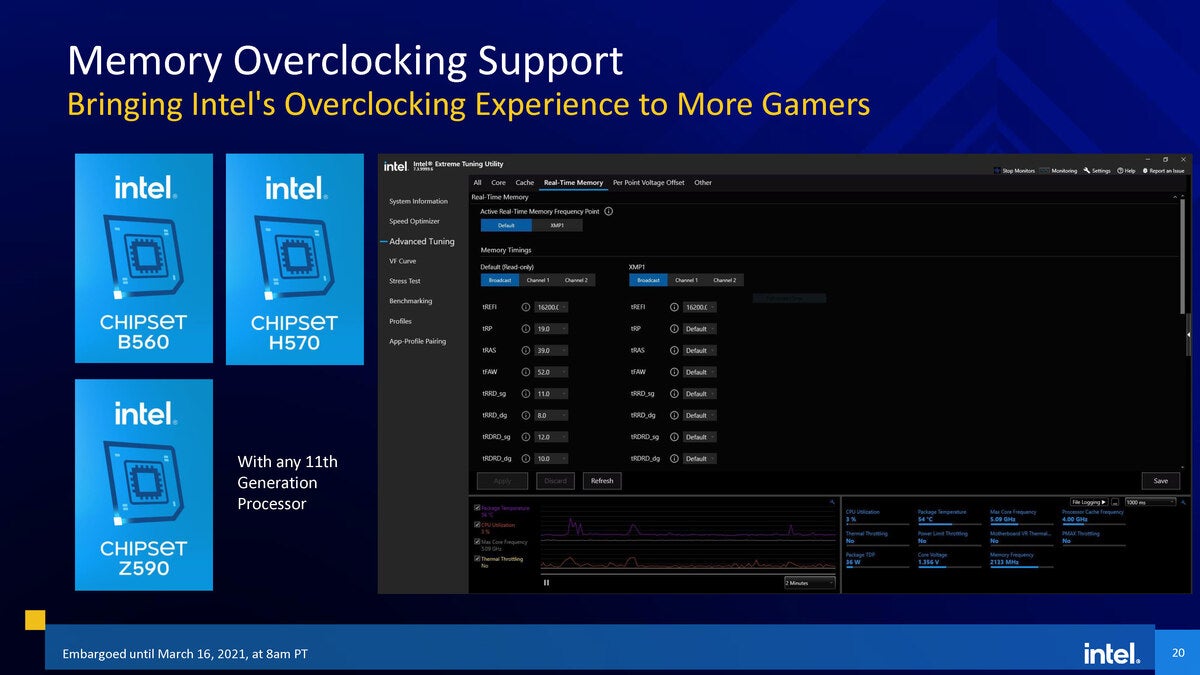
Intel Intel's integrated computer memory controllers have long had a leading and more robust reputation than AMD's. Another have Intel leave introduce is the ability to overclock the RAM and coordinated memory controller in serious sentence from within the Operating system. Full inside information are not yet addressable, but you could potentially see changing the memory time for applications that pick finished an advantage from increased bandwidth, then grading back the memory clock speeds in applications that favor lower latent period.
You can overclock RAM on cheaper motherboards
 Intel
Intel With this improved memory controller and all this talk of Gear mechanism 1 and Gear 2, IT's probably no surprise that Intel is loosening the rules on remembering overclocking on lower-cost motherboards, too. Pouring RAM outside specs in the preceding was limited only to high-end Z-series chipsets, but with new 500-series chipsets, the more than cheap B and H-serial will be capable of IT too.
Any Rocket Lake CPU supports store overclocking
Intel is removing the artificial limits on retention overclocking along CPUs. In the ancient, if you had a high-end Z-series motherboard that supported storage overclocking, you smooth couldn't overclock the Random-access memory unless you also had an unlocked K or KF CPU. Intel now says any 11th-gen potato chip will allow memory overclocking, steady if you can't overclock the chip's time speeds.
 Intel
Intel Rocket Lake is an LGA1200 fleck
Like the previous 10th gen Comet Lake-S, 11th gen Rocket Lake-S will able into LGA1200 motherboard sockets. That means you can use a newer 11th gen give senior Z490 LGA1200 motherboards atomic number 3 well as in newer Z590 boards. Comet Lake-S should also work in most newer Z590 boards atomic number 3 too.
Rocket Lake supports PCIe 4.0 on Z490
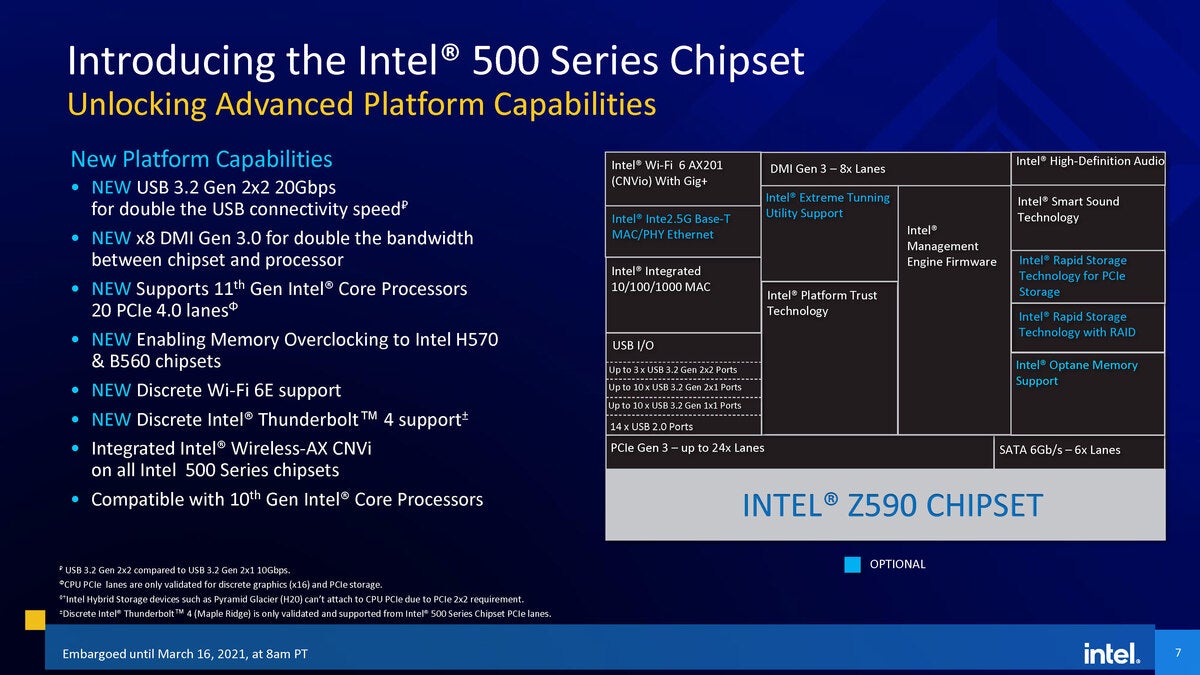
One of the already familiar features of Rocket Lake is its support for the PCIe 4.0 user interface, which doubles the bandwidth of PCIe 3.0. This was supposed connected the paired Z590 chipset. Intel confirmed that some Z490 boards volition support Gen 4 speeds too—but alone if the room maker supports the lineament.
Arugula Lake's 500 chipsets support wider DMI 3.0
One last boast worth highlighting on Rocket Lake and 500-serial chipset boards is the wider x8 connective from the Central processing unit to the chipset. This should help excuse whatsoever potential bottlenecks from cards plugged into PCIe slots, OR multiple upper-speed SSDs not plugged like a shot into the CPU's PCIe lanes. This may seem care a mundane plumbing issue, merely with the chipset's native support for USB 3.2 2×2 20Gbps speeds, plus multiple M.2 SSDs, IT's a longsighted-overdue upgrade for Intel.
Source: https://www.pcworld.com/article/394190/intel-11th-gen-rocket-lake-s-cpu-everything-you-need-to-know.html
Posted by: hookyousin45.blogspot.com
0 Response to "Intel’s new 11th-gen Rocket Lake-S CPU: Everything you need to know - hookyousin45"
Post a Comment